
By The WORTHY Breath & Body Team
A stiff shoulder that won’t loosen up, no matter how much you stretch it.
If that’s been you lately, you’re not imagining it, and you’re not alone. Frozen shoulder, known medically as adhesive capsulitis, disproportionately affects women between 40 and 60. Roughly three out of four people diagnosed with it are women, and the timing lines up almost exactly with perimenopause and menopause.
That’s not a coincidence. It’s hormones, and it’s also something bigger: how the whole body, including the nervous system, responds to a major hormonal shift.
What’s actually happening
Frozen shoulder happens when the capsule of connective tissue around the shoulder joint thickens and tightens, gradually restricting how far the joint can move. It gets its name because that’s what it feels like: the joint locks up, often slowly, sometimes over months, until reaching overhead or behind your back becomes genuinely difficult.
The reason it clusters so heavily around this stage of life comes down to estrogen. Estrogen helps regulate collagen production and keeps connective tissue supple; it also plays a real role in managing inflammation throughout the body. As estrogen declines during perimenopause and menopause, that protective effect weakens. Connective tissue becomes more prone to the kind of fibrosis, tissue thickening and scarring, that stiffens a joint capsule in the first place.
Dr. Jocelyn Wittstein, an orthopedic surgeon at Duke who studied the connection, put it plainly: estrogen “plays a role in stimulating bone growth, reducing inflammation, and promoting connective tissue integrity.” Her research, presented at a North American Menopause Society meeting, found that women on hormone therapy had a meaningfully lower risk of developing frozen shoulder than women who weren’t.
It’s part of a bigger pattern. More than 70% of people going through menopause report some kind of musculoskeletal symptom, and for a meaningful share of them, it’s disabling enough to change daily life. Frozen shoulder is one of the more dramatic examples, but it’s part of the same hormonal shift affecting joints, muscles and connective tissue more broadly.
The nervous system connection
Hormones aren’t the only system involved. There’s a second piece of the picture that gets talked about far less: the nervous system, and specifically, how the body handles stress.
When the body is under sustained stress, the hypothalamic-pituitary-adrenal (HPA) axis, the system that governs your stress hormones, stays switched on longer than it’s meant to. Cortisol, the primary stress hormone, is useful in short bursts. Chronically elevated, it’s a different story: research reviewing the connection between psychological stress and tissue healing has found that sustained high cortisol is linked to reduced collagen production, slower wound healing, and weaker connective tissue generally. One review found that cortisol-driven pathways can cut collagen production by as much as 80% in affected tissue. Connective tissue, the exact material a frozen shoulder capsule is made of, is remarkably sensitive to how much stress the body has been carrying.
The nervous system also runs the other direction. The vagus nerve, the long nerve that connects the brain to most of the body’s major organs, is the main channel of the parasympathetic nervous system, the “rest and digest” side of things, as opposed to the sympathetic “fight or flight” side. Research on what’s called the cholinergic anti-inflammatory pathway has found that vagus nerve activity directly dampens the release of inflammatory signals in the body. In simple terms: a body that’s able to access its own rest state more easily has an easier time keeping inflammation in check. A body stuck in sympathetic overdrive doesn’t.
This is where breath comes in, and it’s genuinely well studied, not just a wellness talking point. Slow, controlled breathing, the kind that’s the entire foundation of a breathwork practice, has been shown in a growing body of research to shift the body toward parasympathetic dominance: heart rate variability improves, vagal tone increases, and markers of stress reliably come down. It’s one of the more consistent findings in this area of research, and it’s part of why breathwork has moved from the fringe into mainstream conversations about nervous system health over the past several years.
None of this means breathwork treats a frozen shoulder capsule directly. It doesn’t, and we’d never tell you it does. What the research does support is something more foundational: a nervous system that’s regularly given the chance to come out of a stress state is a body better equipped, generally, to manage inflammation and support its own tissue health, shoulder included.
The three phases
Frozen shoulder moves through stages, and knowing which one you’re in changes what actually helps.
Freezing. Stiffness builds gradually and pain increases, often worse at night. This stage typically runs six weeks to nine months.
Frozen. Pain tends to ease, but the stiffness itself stays put, making everyday reaches and lifts genuinely hard. This stage usually lasts two to six months.
Thawing. Range of motion slowly comes back, with most people reaching full or near-full recovery as strength returns.
What helps early, before you have a diagnosis
You don’t need to wait for a formal diagnosis to start doing something. The self-care most commonly recommended looks like this:
- Heat before you move. Ten to fifteen minutes of warmth, a heating pad, a warm shower, loosens the joint and surrounding muscle before you stretch.
- Gentle, frequent stretching. Short sessions done several times a day beat one long one. A simple wall-walk, fingers creeping up a wall in front of you, is one of the most commonly recommended starting points.
- Stretch to tension, not pain. If it’s sharp, or it’s still sore the next day, that’s too far.
- Add strength once the sharpest pain eases. Isometric work, contracting the muscle without moving the joint, is usually the entry point, since it builds strength without aggravating a stiff capsule.
- Give your nervous system somewhere to land. This is the piece that’s easiest to skip and, per the research above, one of the more foundational ones. A regular breath practice, even five or ten minutes a day, is one of the more accessible ways to give your body’s stress response somewhere to come down.
If you’ve been doing this consistently and aren’t seeing progress, or the pain is severe enough to disrupt sleep or daily life, that’s the point to bring in your doctor or a physical therapist for an actual diagnosis and a real plan. Self-care is the start, not the whole answer.
Where a place like ours fits in
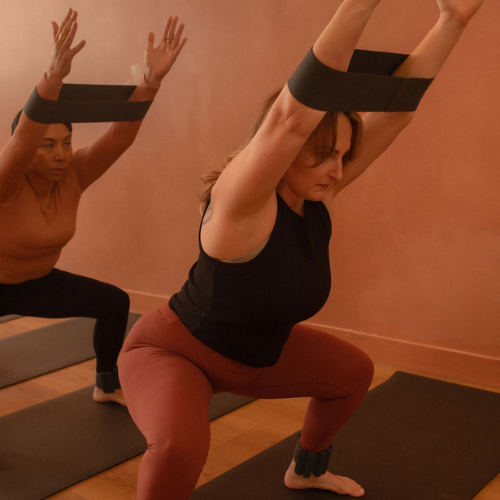
WORTHY Breath & Body is built around exactly this: classes that work the body while working the nervous system alongside it. The shoulder is the most mobile joint in the body, held together by 17 surrounding muscles, and every class on our schedule works with it in its own way:
I am ALIGNED and I am ALIGNED Sculpt move through sculpting sequences that open the chest and awaken the upper back, blending strength with shoulder mobility while core and legs stay engaged. ALIGNED Sculpt holds that same work longer, for slower, more deliberate strengthening through the same range.
I am SCULPTED holds proper chatturanga, push-up and plank alignment longer, plus rowing, pulling and pushing work with weights.
I am POWERFUL is built around upper body pushing patterns for strength, stability and mobility right through the shoulder.
I am IN FLOW moves through asanas that build both mobility and stability: Dolphin Pose, Eagle Arms, Cow Face Pose.
I am COSMIC works the shoulder differently, releasing tension in the thoracic belt through breath, inhale as the shoulders rise, exhale with a full release, the same slow-breath practice the nervous-system research above is describing.
I am LIFTED pairs overhead reaching in barre work with breath-led release.
None of these are a treatment for a stiff shoulder capsule. All of them are real, different ways of asking the shoulder to move, strengthen, and release, alongside a nervous system that’s getting regular practice coming down from a stress state.
If frozen shoulder is part of what you’re navigating right now, whether you’re still in the self-care phase or already working with a PT, come build the rest of your recovery routine around it with us.
Have questions about a specific symptom or condition? That’s a conversation for your doctor. We’re always here to help you build the self-care and nervous-system side of your routine around whatever they recommend.